Travel with Tobey and Sue

Travel with Tobey and Sue
Tobey and Sue in Africa

Saturday, August 4, 2012

Hot August Nights 2012 - August 3

We are headed to Reno, Nevada to join friends at the Hot August Nights car extravaganza which begins August 7th. The RV was loaded and we were planning to leave Fort Collins by 9:30 this morning. Well, I wasn’t quite ready, then it was 9:45 and before we even hit the highway, we ran into road construction which delayed us ANOTHER 15 minutes. THEN, as we were driving north on CO Hwy. 287, we were stopped by a Larimer County sheriff because we were – are you ready for this? – GOING TOO SLOW! 56 mph in a 65.He didn’t give us a ticket, just a little talk and said we needed to speed up and pull over when there were too many cars behind us. That slowed us down another 15 minutes. In the big scheme of things on getting to Reno, not a big deal. Today, however, we wanted to reach Laramie, Wyoming to make the 11:00 am tour at the Territorial Prison. We arrived just as the tour was starting and missed only the first five minutes!P1020774The prison is one of only three federally constructed territorial penitentiaries that still exist in the western US and has most of the P1020765original structure preserved. It was built in 1872 and for 30 years held violent and desperate outlaws, including the notorious “Butch Cassidy.”

After the tour and lunch, we were headed west on I-80 toward the White Mountain petroglyphs north of Rock Springs. If you have ever been to Wyoming you might know that the wind blows most of the time and today it was blowing straight at us - at 35 mph! It made for slow going and poor gas mileage. To top delays off,  I forgot to pack the phone chargers and when Tobey’s phone went dead we had to make another stop to buy a charger.

We finally turned north leaving Rock Springs behind about 5:30 pm. The petroglyphs are about 20 miles north of Rock Springs on a gravel road – washboard gravel. It took an hour to get here! After a quick dinner we took a short walk up to see them – and they are amazing.

P1020800Etched into the sandstone surface some 200 to 1,000 years ago, several figures appear to portray bison and elk hunts while others depict geometric forms or tiny footprints. P1020792Handprints are worn into the rock, as well.P1020807Higher up on the rock outcropping were three or four huge nest, maybe eagle nests. P1020791We will hike back in the morning for a longer look before heading out. We both miss having the “Banda” portable internet we had while traveling in Mexico – we will have to wait for a free WIFI spot before we can post!

Friday, August 3, 2012

European Vacation #11 - On to Germany

On June 25 Wendy and Amanda flew home while Tobey and I went on to Germany. We have hosted six exchange students, five from Germany, and thought it would be a good opportunity to visit since we were so close.

We picked up a car in Frankfurt and drove south to Schaffhausen, Switzerland – about an hour from Zurich, where Tom, our first student, now lives. Our second student, Stephan, is now living in Zurich also, so we also had a chance to have dinner in Zurich with both of the “boys.” They had the opportunity to meet several years ago when they both came back for a visit so they keep in touch, also.


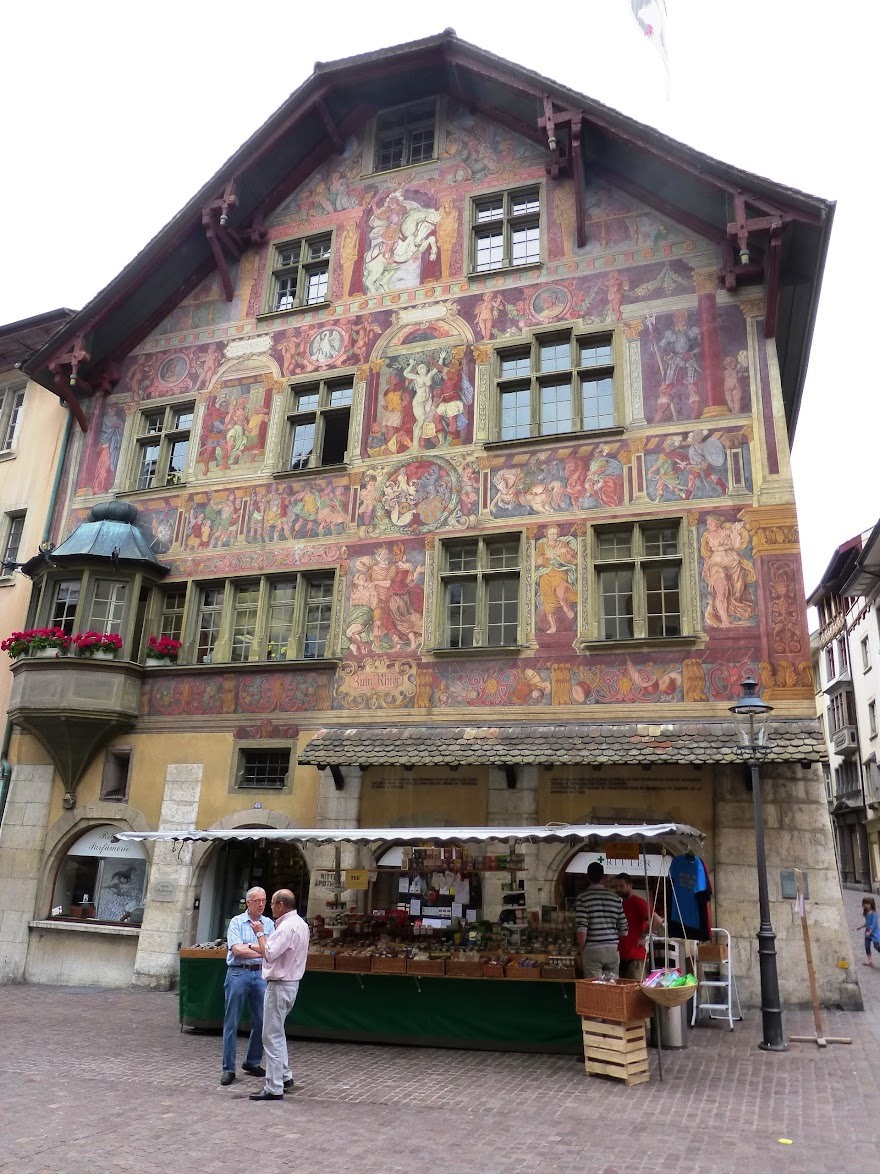
We had fun exploring Schaffhausen and the surrounding area. It is a charming little town, complete with a castle.

Before leaving Schaffhausen, we drove to the Rhine Falls.
As we entered the parking area we noticed a sign that said “frei” which we assumed meant “free parking.” Well, you know what they say about assuming things … Anyway, we had to pass through a gate and get a ticket, but thought it was probably so they would know how many people came through the area. Well, after seeing the falls and snapping a few pictures we headed back to the parking lot. Imagine our surprise as we drove up to the exit, inserted our ticket, and the booth said to return to the payment kiosk! Guess “frei” isn’t free. Okay, we went back and the kiosk indicated we could pay in Euros or Swiss francs – no problem, we had Euros. The machine wouldn’t take them – and we tried every one we had! We set off back down the hill to the shops in hopes of getting change, but our smallest Euro bill was $50 and didn’t want $45 worth of francs since we were heading to Germany! Tobey found a park worker and attempted to explain our dilemma. He looked at our ticket and motioned for us to meet him back at the parking lot. He drove through with his truck, gave us his new ticket and we were able to exit without paying anything since we were there less than 15 minutes. Who would know that “frei” really means that it was open?

From Schaffhausen, we headed east to Munich with a stop at Paul’s, our last student. Along the way we drove through miles and miles of “green farms” where buildings, houses, and barns are covered in solar panels. It was quite impressive.
We were in Munich when Italy and Germany were playing in the Euro Cup so it was quite exciting since Paul’s mom is from Italy! We could cheer for either team and be on the winning side – but they were actually happier that Italy won in that round! We went to the BMW Museum, the Olympic Park, Scholss Nyphenburg, and had fun touring in the Englischer Garten. It was fun to see kids “surfing” on a man-made surf in the river that runs through the garden. We even had dinner in a traditional beer garten – even though neither of us drinks beer!

Another bonus in Munich was seeing Alex, our “step” student. He was here the same year as Tom, but lived with another family, and they became good friends. We have enjoyed his friendship through the years and had fun touring “old town Munich” with him.
From Munich we went west to Erbach. Stephan (#2) came from Zurich to join younger brother, Christoph (#4) and his parents for the weekend. We had a wonderful time sharing stories and friendship.
We had planned to meet Hauke (#3) in Stuttgart on our return to Frankfurt. He is now flying regional planes for Lufthansa and his schedule changed at the last minute, so we didn’t get to see him. We were really disappointed. Tobey wanted to find out if Lufthansa honored the "family members fly for free” that some airlines offer, and whether host parents qualified as family! Maybe next time.

Our week in Switzerland/Germany came to an end on July 3rd as we headed home to Colorado. It has taken me a while to get all of the posts finished, but one month later, this is it! Just in time, too, because we are heading out in the RV today for a 3-week adventure.

Wednesday, August 1, 2012

European Vacation # 10 – Prague - This and That - Odds and Ends

Prague is home to a number of famous cultural attractions, as well as many world-class museums. We went to the Veletržní Palác to see an incredible exhibit, “The Slav Epic” by Alfons Mucha. The 20 murals, painted between 1910 and 1928, were hidden away in monasteries during the war and discovered in the 1960s. Many were damaged and the restoration completed about 1968. No pictures were allowed in the exhibit, but you can check out this website to get an idea of what they are like – it is well worth checking. http://www.artdaily.org/index.asp?int_sec=2&int_new=55340

We also walked through Josefov, Prague’s Jewish Quarter, looking at what was once the largest Jewish ghetto in Europe.

The Spanish Synagogue was built in 1868. During WWII, the Germans used the building as a repository for property taken from the Jews.

Here’s an oddity in the Jewish Quarter: a church. This mid-14th century Gothic church sits right in the middle of Josefov and used to divide the Jewish community — literally and figuratively. Just outside is a statue of Franz Kafka, an author, who was born and raised in this area.

Our wanderings also took us to the John Lennon Peace Wall. The formerly ordinary wall has been called Lennon´s since the 1980s, when people filled it with John Lennon-inspired graffiti and pieces of lyrics from Beatles songs. Why? Lennon was a hero to the pacifist youth of Central and Eastern Europe during the totalitarian era. Prior to 1989 when communism ruled, western pop songs were banned by Communist authorities, and especially John Lennon´s songs, because they were praising freedom that didn’t exist here. Since his death in 1980, he has become a sort of hero to the youth in Prague. The youth defied authorities, even risking prison, when they painted the graffiti. The Communist police kept whitewashing over the portrait and messages of peace, but they could never manage to keep the wall clean. Even the installation of surveillance cameras and posting an overnight guard couldn’t stop the opinions from being expressed. It was a small war of Czech people against communism. Originally covered in anti-Communist graffiti, now it is covered in messages of love and peace.

While most of Prague’s buildings escaped destruction during WWII, Prague itself did not escape human destruction. Reinhard Heydrich, a high-ranking Nazi official, was responsible for the death of thousands of Jews in Prague. In 1942 he was assassinated, but the Nazis leveled the village of Lidice and executed villagers in reprisal for the assassination of Heydrich.

We came upon this simulated “concentration camp” and followed the guide telling the story of the assassination of Heydrich and biographies of the key players on both sides. It was well done and very interesting.
Public transportation is inexpensive and easy to use in Prague. We took the tram to Vyšehrad. Vyšehrad is the very first seat of Czech princes and kings, since the first coronated Czech king, Vratislaus I, lived there. Its fortress is located on a high cliff above the river Vltava. The Gothic towers of the Church of St. Peter and Paul stand out on the hill and several of the original statues from the Charles Bridge are located in the cemetery there.
And what kind of tourists would we have been if we didn’t visit the Choco-Factory Museum? It was fun to learn more about the history of chocolate, as well as sample some handmade goodies! http://www.choco-story-praha.cz/en/

We did eat well while we were in Prague – from traditional goulash with bread dumplings to pork smothered in gravy also with bread dumplings!


Desserts were our favorites – and they were plentiful! Crepes with ice cream and chocolate were especially good.
Someone in Prague must be pretty rich. We saw this Porsche one afternoon. We didn’t meet them, so I guess we will have to go back!


European Vacation #9 - Prague Castle and Charles Bridge

Almost undamaged by WWII, Prague is a wonderful combination of cobbled lanes, walled courtyards, cathedrals, and the 9th century Prague Castle. We spent one day exploring the castle. According to the Guinness Book of World Records, “the Prague Castle is the largest coherent castle complex in the world, with an area of almost 70,000 m². A UNESCO World Heritage site, it consists of a large-scale composition of palaces and ecclesiastical buildings of various architectural styles, from Roman-style buildings from the 10th century through Gothic modifications in the 14th century.” http://www.hrad.cz/en/prague-castle/prague-castle-tourist-information/visit-of-prague-castle.shtml

St. Vitus Cathedral is the largest and the most important temple in Prague. Apart from religious services, the coronations of Czech kings and queens also took place here. The cathedral is a place of interment of remains of provincial patron saints, sovereigns, noblemen and archbishops. The cathedral is the third church consecrated to the same saint on the identical site with the first construction beginning about 925 AD.


Walking through St. Vitus Cathedral was amazing. All along the length of the cathedral the nave is lined with chapels which have stained glass windows and elaborate altars.


Fanciful gargoyles serve as water spouts outside St. Vitus Cathedral!

The 14th century was a time of prosperity for Prague Castle when it first became an imperial residence, the seat of the ruler of the Holy Roman Empire. The royal palace was rebuilt several times and the fortifications strengthened. We walked through parts of the Royal Palace which are currently being renovated. The best thing was all the coats of arms decorating the walls of the room where they used to keep the land rolls. It seems everyone in old Bohemia got a coat of arms, from the King to the Scribes assistants assistant.

The Golden Lane originated after the construction of the northern wall of the Castle. The area consisted of modest dwellings which were inhabited by the castle servants, perhaps goldsmiths. The name "Golden Lane" is documented from the 16th century. The tiny houses were occupied until World War II, but care was taken to ensure that the picturesque character of the lane was not changed.
Today, little shops fill the houses.
The Powder Tower was the largest of the cannon towers, but it was never put to the test. Weapons from times-gone-by were on display.
Today Prague Castle is still the seat of the head of state. The crown jewels are kept in Prague Castle, as well as the relics of Bohemian kings, precious Christian relics, art treasures and historical documents. Our view of Prague from the Castle.

The Charles Bridge is a stone Gothic bridge that connects the Old Town and Malá Strana. Its construction began in 1357. It is said that egg yolks were mixed into the mortar to strengthen the construction of the bridge.
There is a tower standing on each end of the bridge. Baroque statues were placed along either side of Charles Bridge in the 17th century.
The most popular statue is probably the one of St. John of Nepomuk, a Czech martyr saint who was executed during the reign of Wenceslas IV by being thrown into the Vltava River from the bridge. The plaque on the statue has been polished to a shine by countless people having touched it over the centuries. Touching the statue is supposed to bring good luck and ensure your return to Prague.
The statue below was NOT on the Charles Bridge, but we did find it entertaining!

Next post – this and that – odds and ends of Prague.