Travel with Tobey and Sue

Travel with Tobey and Sue
Tobey and Sue in Africa

Thursday, October 3, 2019

October 3, 2019 - Colonial Williamsburg, VA

Last night we headed to the hot tub to relax only to find it wasn’t hot! Bummer!!! We survived, and headed off this morning to explore more of Colonial Williamsburg.

Our first stop was the Randolph House. The deep red Peyton Randolph House is one of the oldest, most historic, and most beautiful of Colonial Williamsburg's original 18th-century homes.

The west wing of the impressive house has stood at the corner of Nicholson and North England Streets since about 1715. Among the historic figures that took shelter in the house were General Rochambeau and the Marquis de Lafayette. Peyton Randolph, Speaker of Virginia's House of Burgesses in the years leading to the Revolution, brought his wife, Betty Harrison Randolph, to the home by 1751. It became a hub of political activity, and its owner Peyton Randolph was elected the presiding officer of the First Continental Congress at Philadelphia in 1774. An inventory taken at Peyton Randolph's death in 1775 indicates how the house was furnished and equipped.
The 30-minute tour through the house was informative and a great start to our morning. Afterward, we continued eastward down Nicholson Street stopping by the brickyard. The brickmakers told us they have completed making 21,000 bricks this summer and are beginning the construction of the kilns for firing the bricks.
The bricks are hand made, moved in the small carts below, stacked and dried/cured for a few months, and then fired at 2000 degrees for five days. Labor intensive work, for sure! The bricks are made for use in Williamsburg and sometimes other historic sites around the country.
We also saw the Public Gaol (jail) and Presbyterian Meetinghouse before our tour of the Capitol building.
Our guide gave the history of the building and the government as it evolved from an elected “house of representatives” and appointed “council” as an English Colony to the house and an elected upper house, or the Senate when the country started the Revolution.
Back on the Duke of Gloucester Street, we also toured Wetherburn’s Tavern. It was interesting to learn the differences between taverns and other accommodations during the 18th Century. A tavern provided not just drinks, but rooms and meals where a public house might offer just sleeping quarters and a meal.

Wetherburn’s was apparently quite a lively place, especially during the time when the court was in session. Subscription dances - where the attendees paid an admission price to attend – were popular. The kitchen was in a building behind the tavern, as well as a dairy house, slaves rooms and the livery stable.
The Market Place showed the area where local merchants set up their temporary stands on Market day.
Every stop was interesting and we gained a greater appreciation for colonial life. At the silversmith’s shop, she explained not just the process of making silver products, but the economic times and reasons folks had silver products made.

The Milliner and Mantua-maker shop was another stop. The Mantua-Maker is a historical sewing pattern company specializing in women's clothing. All patterns are multi-sized, and are based on actual garments, pattern drawings, or engravings and photographs made during the time the garment was worn. Often, garments were imported from England in standard sizes, like small, medium, and large and sold that way. Customized clothing was also available.
One of our last stops was the Apothecary shop. A colonial apothecary practiced as doctor. Records kept by 18th-century Williamsburg's apothecaries show that they made house calls to treat patients, made and prescribed medicines, and trained apprentices. Some apothecaries were also trained as surgeons and man-midwives.

Medical treatment was expensive and individuals frequently diagnosed their own problems and compounded medications guided by tradition, folklore, or domestic medical books. Headaches were often treated by vinegar of roses, a remedy made of rose petals steeped in vinegar and applied topically.

Williamsburg apothecaries also sold cooking spices, candles, salad oil, anchovies, toothbrushes, and tobacco, making them true precursors of today's drugstores.
After another hot (93 degrees) day, we headed back to the Visitor’s Center parking and enjoyed the architecture in the colonial village on our way.

Dinner tonight was at Rocco’s where we shared a beef brisket dinner, mashed potatoes, smoked beans, and the most delicious corn bread! We were both stuffed and I am glad we opted to share.

The hot tub is supposed to be fixed, so we will head there in a while to relax and ease our weary feet! It is hard to believe we only have one more day here before heading home.

Wednesday, October 2, 2019

October 2, 2019 - Colonial Williamsburg, VA

This morning we headed over to the visitor’s center at Colonial Williamsburg to start our tour of the area. We watched a brief film then followed the walking path a short 1/3 mile to Colonial Williamsburg. We passed by a windmill which were common in colonial Virginia and were often shown on early maps of the region. Windmills like this one require 15 mph winds to operate and were often built on high ground near rivers. They were used to grind corn into cornmeal for local farms.
As we entered the residential area of Colonial Williamsburg, the Governor’s Palace was our first stop. The official residence of the Royal Governors of the Colony of Virginia, it was also a home for two of Virginia's post-colonial governors, Patrick Henry and Thomas Jefferson, until the capital was moved to Richmond 1780.

Construction was commissioned in 1706, however, mismanagement of funds, shoddy construction and workmanship delayed the completion for many years.

When Governor Dinwiddie arrived in 1751, the work was still under way and the colony had to buy a house next door – today's Robert Carter House – so the governor would have someplace to stay! After Dinwiddie moved into the Palace in 1752, the rear wing with its ballroom and supper room was raised.


The main house burned down in 1781, though the outbuildings survived for some time after. To confirm what our friend, Harold, asked, yes, the College of William and Mary is located here in Williamsburg. As a matter of fact, the site passed to the College of William and Mary (the second oldest college in the United States) after the Revolutionary War. Two school buildings stood on the Palace grounds, just in front of the buried foundations on the site, when The Colonial Williamsburg Foundation purchased the property in 1928.

Through artifacts, Jefferson's drawings, General Assembly records, and a copperplate engraving discovered in England's Bodleian Library in 1929, reconstruction of the original buildings was completed and they opened as an exhibition on April 23, 1934.

We met many citizens of Colonial Williamsburg today and they were most helpful in telling us of the events of the “days”.

We passed the gardens behind the Governor’s Palace on our way to the Boxwood maze.

We managed to find our way INTO the maze, but had to retrace our steps to get out of the maze! From a view atop the icehouse mound, we could only see one way in and one way out, so we didn’t feel so bad!

We stopped into the Wythe House and the Play House Stage along the Palace Green. At the Wheelwright shop, we learned about making wagon wheels and the apprenticeship process.

Our next stop was Bruton Parish Church which has been a parish for more than 300 years. During the Revolutionary and Civil Wars, the pews were removed and used as firewood and the church served as a hospital for wounded soldiers.
After stopping at several of the different trades’ shops, we made our way to the Courthouse. Tobey and I were both selected to serve as “magistrates” as court cases were presented. It was fun to see how the courts were held and what type of cases were brought before the courts.
Tobey was innocent (actually, he was never even charged with any crime), but he was a good sport and posed for a picture in the stocks! I think I have a picture of Tyler in the same place 24 years ago that I will look for when we get home!
At the Magazine and Guardhouse, we met Marie-Joseph Paul Yves Roch Gilbert du Motier, Marquis de Lafayette, known in the United States simply as Lafayette. He was a French aristocrat and military officer who fought in the American Revolutionary War, commanding American troops in several battles, including the Siege of Yorktown. He answered questions about his involvement in the war and how he helped George Washington win the war.
Outside, in the grounds, we also met a Shawnee Indian who demonstrated his bow and arrows, and gave a wonderful history of the native philosophy. It was very interesting!
As the day was winding down, we strolled down Duke of Gloucester Street and enjoyed seeing the horse-drawn carriage passing by.
Our final stops were at the Print and Bindery Shops. It was fun to watch the printer demonstrating how they printed books and papers in the 1700s.
As we left the shops, we could hear the fife and drums so we headed to the Prentis Field, where the band was performing. If you want to hear them, you can follow this link: https://youtu.be/RahIZUw-FPw

As they passed us, we noticed most of the players looked to be quite young – middle school to high school age!
It was a long, hot (95 degrees) day and we are happy to be resting this evening! We are off to the hot tub to rest our weary feet before we tackle another section of Colonial Williamsburg tomorrow.

Tuesday, October 1, 2019

October 1, 2019 - Yorktown, VA

This morning we headed back to the Jamestown Settlement to visit the indoor museum areas we missed yesterday. There is so much information and it is so well done! We really enjoyed the exhibits and artifacts on display. The sad part is you are not allowed to take photos indoors, so we just have those Kodak moments in our mind!

From Jamestown, we headed north to the American Revolution Museum at Yorktown.

We watched their introductory movie before spending a couple hours inside the museum reviewing our Revolutionary War time history. Again, no photos, but the museum is so well done and we learned much!

Outside, we walked through the recreated Continental Army encampment and listened while “soldiers” told us about their life and experiences during the war.

This was the firepits used for cooking by the regiments. Each tent was assigned a section for their cooking needs.

The museum also had a Revolution-era farm with a family working the different areas.


The “mother” explained eating habits, food storage, and cooking during the time period.

We headed over the Colonial National Historic Park at Yorktown, run by the National Park Service after we finished our outside tour at the museum. We had free admission with our National Parks pass – we love having that pass!

We arrived in time to join a ranger-led talk about the final battle at Yorktown. He did a fantastic job explaining the history, the people involved, the part that luck and timing played in the siege, and the results. Tobey and I agreed it was probably the best ranger talk we have ever experienced!

We followed the Battlefield Driving tour making Redoubt 10 our first stop. On October 14, 1781, French troops helping the American troops stormed the British-held Redoubt 9 while American troops stormed Redoubt 10, capturing both positions in less than 30 minutes. This allowed the Allies to complete their second siege line and construct a Grand American Battery for siege artillery between the two redoubts. Three days later, British leader Cornwallis proposed a cease-fire. This is the remains of Redoubt 10. Much of the land has fallen into the York River over the years.

Our next stop was at the Moore House where officers from both sides met to negotiate the surrender terms for Cornwallis’s army on October 18, 1781.
Eighty years later, during the Civil War, military action around Yorktown caused considerable damage to the Moore House. Sitting in between Confederate lines in Yorktown and the Union forces on Wormley Creek, the house was within easy range of shell fire. Later, foraging soldiers stripped away siding and other usable wood for fuel.

The house remained derelict until 1881 when much needed repairs and some additions were made in preparation for the Centennial Celebration of the allied victory at Yorktown.
Between 1931 and 1934, the National Park Service, which had just established Colonial National Monument (later Historical Park), restored the Moore House to its original colonial appearance.

The driving tour continued to “Surrender Field” where Cornwallis’s army marched and laid down its arms on October 19, 1781. This ended the last major battle of the Revolutionary War and virtually assured American independence, even though the Treaty of Paris was the official peace treaty between the United States and Britain that ended the American Revolutionary War was not signed until September 3, 1783. The Congress of the Confederation ratified the treaty on January 14, 1784. King George III ratified the treaty on April 9, 1784 and the rest is history.

It was a long day, and we got back to the condo about 6 tonight. Tobey is fighting a cold so he is calling it an early night. Hopefully, he will feel better after a good night’s rest. Tomorrow we are hoping to visit Colonial Williamsburg.

Monday, September 30, 2019

September 30, 2019 - Jamestown, VA

This morning we attended our “90 minute” timeshare presentation … and it only lasted a little over 2 hours. That obligation out of the way, we headed to the Colonial Jamestown Island under cloudy, cool weather – a big change from yesterday! Jamestown Island is the original site of the first permanent English settlement in North America.

With our national parks pass, admission was only $5 per person. The park had an interesting film we watched before touring Jamestown Historic Park.

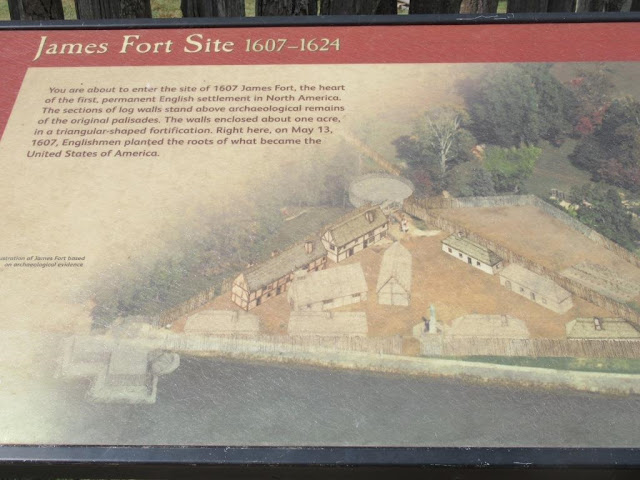
So now is your first little history lesson. In 1607, three wooden ships, Susan Constant, Godspeed, and Discovery, carried 104 Englishmen and boys across the Atlantic and landed at a tiny island on the river they named the James in honor of the English king. The Powhatan Indians attacked within days of their arrival. The English built a triangular fort for defense. John Smith became the leader of the settlers. This is an illustration of what the acre sized fort looked like from the site excavation.
When the English arrived and settled Jamestown in May 1607, Pocahontas was about eleven years old. Pocahontas and her father would not meet any Englishmen until the winter of 1607, when Captain John Smith (who is perhaps as famous as Pocahontas) was captured by Powhatan's brother Opechancanough. Once captured, Smith was displayed at several Powhatan Indian towns before being brought to the capital of the Powhatan Chiefdom, Werowocomoco, to Chief Powhatan. What happened next is what has kept the names of Pocahontas and Captain John Smith are forever linked: the famous rescue of John Smith by Pocahontas. As Smith tells it, he was brought in front of Chief Powhatan, where he was to be killed. Before this could happen, Pocahontas rushed in and placed her head upon his, which stopped the execution. Whether this event actually happened or not has been debated for centuries. Smith was then allowed to leave Werowocomoco.

Once Smith returned to Jamestown, Chief Powhatan sent gifts of food to the starving English. These envoys were usually accompanied by Pocahontas, as she was a sign of peace to the English.

The Werowocomoco, however, got tired of providing food to the settlers, and moved their village further away from the Jamestown colony.

The English had hopes and dreams of finding gold and wealth. In 1608, another group of skilled laborers arrived increasing the settlement’s population to more than 200. Instead of wealth, they suffered many hardships and during the winter of 1609-10 known as the “Starving Time”, all but 60 colonists died by winter’s end.

In 1613, Pocahontas was kidnapped by Captain Samuel Argall and brought to Jamestown. Powhatan, informed of his daughter's capture and ransom cost, agreed to many of the English demands immediately, to open negotiations for her rescue. In the meantime, Pocahontas learned the English language, religion and customs. While not all was strange to Pocahontas, it was vastly different than the Powhatan world.

During her religious instruction, Pocahontas met widower John Rolfe and the two fell in love. John Rolfe was one of the Virginia Colony settlers and is credited with the first successful cultivation of tobacco as an export crop.

In 1614, Pocahontas married John Rolfe resulting in a 7 year peace with the Powhatan Indians.

By 1619, the Virginia Company began sending “maids and poor children” to boost the population. The colony grew and commerce was dependent on tobacco production and export to England. This also led to enslaved Africans being brought to the colony.

We enjoyed all of the historical information at the site, both outdoors on the archaeological site and in the Voorhees Archaearium (museum) and Visitor’s Center.

From the original site, we drove over to Jamestown Settlement, a recreation village, museum and location of three replica ships. 

We purchased a combo ticket which includes the Jamestown Settlement and American Revolution Museum at Yorktown.

We started with the 30 minute film then headed outside to see the recreated Powhatan village, ships and James Fort. It was interesting. This is the site that I visited with Tyler 24 years ago! There are “Powhatan” Indians in the site, dressed in costume, showing the activities of the tribe from the 1600s and answering questions.
 
We looked at the ships that were built in the 1990s as recreations of the original three English ships to arrive in Jamestown. The three ships carried a total of 104 people and took 144 days to arrive from England! Small quarters and not very pleasant conditions – this would not have been my choice to make this journey!


In the recreated Fort James, again, there were character actors who “lived” in the fort and demonstrated what life would have been like.

We even got to see a black powder musket firing demonstration before heading back to the Galleries to see the inside exhibits and artifacts.
Unfortunately, it was almost 5pm and closing time. Luckily, they were really great about extending our ticket so we can go back tomorrow to see the inside exhibits.

We drove along the Colonial Parkway back to the condo and saw a helicopter hovering near the water on the James River. All we could figure was it was in training as it made several “dip and hover” type moves before circling back and doing it again. Interesting to watch!

We are both tired after our day, so we stopped at the grocery store and picked up some soup for dinner. We are hanging out tonight and will continue our historic tour tomorrow.

Sunday, September 29, 2019

September 29, 2019 - Busch Gardens, VA

We slept in a bit this morning – 8:30 – but then we were on our way to Busch Gardens arriving there about 10 am.

The park has grown and changed since I was last here about 24 years ago with Tyler and our friend, Susan, and her girls, Lauren and Melissa. The rides have grown in size and loops!! Tobey and I managed to go on all the rides except the “Griffon” which they closed down midday because of wasps that were hanging out at the top of the ride. The park has also closed all of their “water” rides for the winter, so that was a bit disappointing. Several rides we went twice without waiting!

The ride in the picture below is called the Tempesto. We only rode this once – and I had my eyes shut almost the entire time – but it was fun.

The park is set up in a “country” theme, so today we went to England, Ireland, Scotland, France, New France, Germany, and Italy!

The lines were pretty short – our longest wait was about 15 minutes! On our way out of the park, we went by the the “Verbolten”! I’m glad we didn’t miss it – it was really fun. It was fast, had a long looping section through a dark tunnel, a floor drop section, then ended with this drop before going back to the loading area.

Temperatures hit 90 today, so we were worn out by 5pm, and headed back to our condo. Around 7, we went out to dinner at Jose Tequila's Restaurant. The food was pretty good and we had plenty of leftovers for another day! Back at the condo again, we relaxed in the hot tub and had fun visiting with other guests staying here. Tomorrow morning we will go have breakfast and listen to the resort’s time-share presentation before getting on with the rest of our day.

Saturday, September 28, 2019

September 28, 2019 - Fort Collins, CO to Williamsburg, VA

Last year when Tobey and I went to Cabo San Lucas, Mexico we received a free week stay as a promotion for a timeshare presentation we attended. Today we embarked on our journey to Williamsburg where we are redeeming that week!

We were up at 2:00 am and on the road to the airport by 2:30 for our 6:00 am flight! UGH. The flight from Denver was pretty bumpy, but we arrived in Philadelphia on time. With almost a 3-hour layover, we headed to the Centurion Lounge for lunch and a chance to stretch before getting the commuter flight to Newport News, VA. Again, uneventful, and only one hour. After picking up the rental car it was a short 20 minute drive to the Wyndham Kingsgate condos which will be our home base for the next week.

We took a short drive around Colonial Williamsburg before picking up some groceries for breakfast and a take-out pizza for dinner.

It will be an early night for us tonight since we are going to Busch Gardens tomorrow which will be a full day! I am looking forward to visiting several historical sights and having some amusement park fun this week! And, a big thanks to our moms, Beverly and Ruthellen, who are staying at our house and taking care of our dog, Penny, while we are gone.